
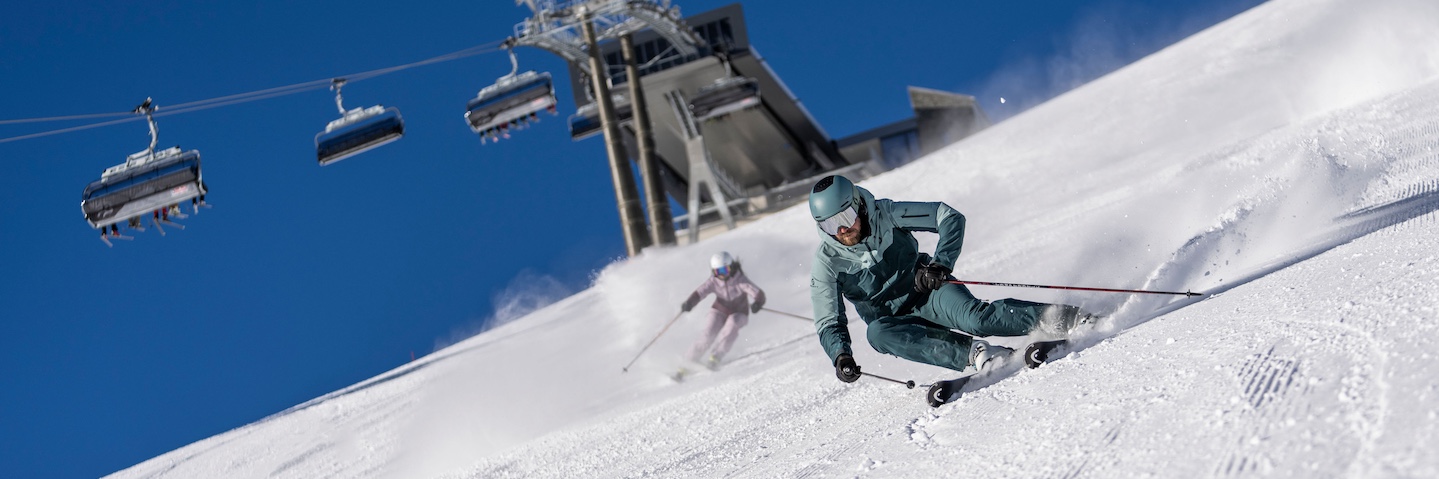
Why skiing is one of the most comprehensive longevity programs
Michaela Altenberger,
Why does skiing affect mitochondria, blood vessels, and the nervous system—and not just the muscles?
Why does an intense day of skiing often feel more rejuvenating than a whole day on the couch?
And what role do mitochondria, cold, and heat play in genuine, lasting regeneration?
Skiing is longevity training in its purest form – provided you view it not only as a recreational sporting activity, but also as a biologically effective stimulus on several levels. Hardly any other activity combines strength, endurance, coordination, altitude, cold, focus, and regeneration so efficiently.
This is precisely where the difference lies: skiing does not work in isolation, but systemically. It is therefore one of the most comprehensive health programs that can be implemented without technical equipment but with maximum biological effect – especially when movement, altitude, cold, and regeneration are sensibly combined.
At the Krallerhof, this results in a structured longevity cycle that addresses energy production, regeneration, and the nervous system in equal measure.
Point 1: Altitude training and mitochondria
Skiing is a full-body workout with high physiological density. The altitude of around 2,000 meters puts the mitochondrial system under targeted pressure. Due to the lower partial pressure of oxygen per breath, energy production becomes less efficient in the short term.
It is precisely this deficiency that is the stimulus: the organism is forced to optimize its mitochondrial performance. The mitochondria respond with higher efficiency and more stable ATP supply. This effect follows the same principles as modern hypoxia training – but in a dynamic, coordinated way and embedded in natural movement.
At the same time, oxygen uptake adapts. The body reacts to the thinner air by increasing the production of red blood cells in order to improve supply in the long term.
Point 2: Natural interval training
At the same time, skiing functions like intelligent interval training. Intense descents alternate rhythmically with short recovery phases on the lift. Heart rate, vascular tone, and metabolism respond precisely to these changes.
Studies show that this dynamic has positive effects on VO₂max, insulin sensitivity, and vascular function. The body is challenged without being permanently overloaded. This makes the training stimulus particularly sustainable and well tolerated—even over several days.
Point 3: Balance, sensory perception, and brain performance
Then there is the neural component. Skiing trains balance, reaction speed, and forward planning at the same time. Assessing speed, reading lines, anticipating terrain, taking other skiers into account—all of this requires close cooperation between sensory perception, motor control, and cognitive processing.
This integrative approach fundamentally distinguishes skiing from many monotonous forms of training and makes it a highly effective stimulus for the brain.
Point 4: Regulation of the nervous system
Skiing does not work without presence. While skiing, there is no room for repetitive thoughts or mental digressions. Your gaze, body axis, surface, and speed must be constantly coordinated.
Neurobiologically, this means a shift away from stress-driven rumination toward focused control. The activity of the amygdala decreases, and the prefrontal cortex takes over again. Stress axes regulate themselves. After days of skiing, many people report a more stable mood, mental clarity, and significantly better sleep.
Exercise, cold, focus, and nature have a more lasting effect here than any passive relaxation measure.
Point 5: Cold chamber – before or after skiing
A central component of the longevity concept is the targeted use of the cold chamber at around minus 85 degrees Celsius. The decisive factor here is not the stimulus itself, but the timing.
Before skiing, cold has an activating effect. Noradrenaline levels rise, alertness and attention increase, and neuromuscular coordination becomes more refined. At the same time, the pain threshold increases. Thermogenesis is activated, brown adipose tissue begins to produce heat, and the mitochondria increase their activity. Many experience this state as clearer and more stable than after consuming caffeinated stimulants.
After skiing, the effect is reversed. Cold reduces microinflammation, lowers proinflammatory messengers, stimulates lymph flow, and supports the vegetative switch to regeneration mode. Blood vessels constrict and then open up again – an effective stimulus for vascular health and repair.
Point 6: Sauna and heat shock proteins
Heat triggers a specific stress response that is highly relevant to longevity: the formation of heat shock proteins.
These proteins act as a cellular repair system. When the body temperature rises, the cells recognize unstable or misfolded proteins. Heat shock proteins stabilize these structures or ensure that damaged components are broken down and replaced.
This mechanism is central to longevity. Protein misfolding increases with age and is considered a contributing factor to neurodegenerative diseases, chronic inflammation, and declining cell function. Regular heat stimuli train the cells' ability to better cope with precisely this type of damage.
After a day of skiing, this means better blood circulation in the muscles, faster removal of metabolic waste products, and a deeply felt physical relaxation.
Point 7: Red light as a cellular repair impulse
Red light completes the process at the cellular level. Photobiomodulation acts directly in the mitochondria, increases ATP production, reduces oxidative stress, and supports repair processes.
Studies show effects on inflammation regulation, tissue regeneration, and neural function. In combination with cold and heat, a multi-layered regeneration impulse is created: cold regulates inflammation, heat trains blood vessels and the heart, and light strengthens cellular energy production.
Summary: The longevity ski day at the Krallerhof
A longevity ski day at the Krallerhof follows a clear biological rhythm:
A short period of cold exposure to activate the body in the morning, skiing as multi-system training, another period of cold exposure to regulate inflammation, a sauna to adjust the vascular system and circulation, and red light therapy as a repair impulse in the evening.
The result is not a short-term kick, but a measurable shift towards less inflammation, more efficient energy production, and a calm, regulated nervous system.
At the Krallerhof, a day on the mountain becomes a biologically meaningful upgrade day.
Get in touch
Pick your communication channel of
choice - the Krallerhof team is
happy to help you!
 urlaub@krallerhof.com
 +43 6583 8246
 Inquiry
 Booking
 Fb Messenger
 Voucher